The St Matthew Passion: An Immersive Journey
Welcome to one of the most monumental artworks in Western history. Johann Sebastian Bach's St Matthew Passion (BWV 244) is much more than a long piece of music; it is a three-hour journey through betrayal, loneliness, suffering, and ultimate resignation.
011. The Ritual
Today we listen to the St Matthew Passion in large concert halls, but that is not what it was written for. Bach composed it for the Good Friday Vespers service in Leipzig (1727). It was a musical sermon, intended as an intense, collective ritual of mourning. The listeners were not passive; they were urged to reflect on their own mistakes, fears, and hopes.
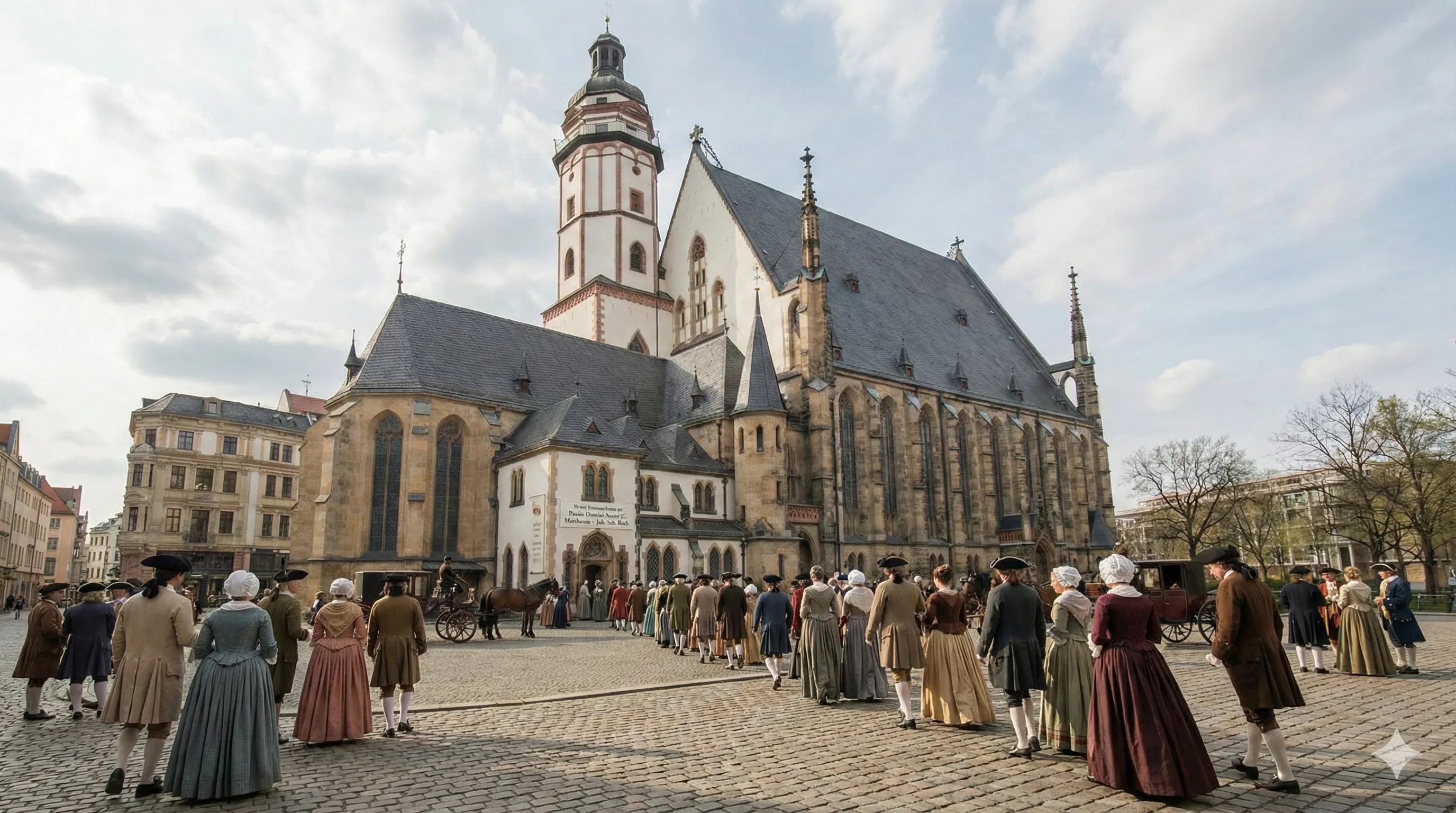
1727 Leipzig
St. Thomas Church
2. The Soundscape
When you first hear the opening chorus, you are overwhelmed. Two orchestras, two choirs, and a boys' choir sing simultaneously. Let's peel back the layers.
The Heartbeat (Continuo)
Underneath everything lies the foundation. The cello, double bass, and organ play the 'Basso Continuo'. This line never stops. It is the rhythmic heartbeat that drives the passion forward for three hours.
The Stereo Effect
Bach divided his musicians into two complete choirs and two orchestras (Choir I and Choir II). In the church, they stood far apart. They sing against each other, ask questions, and interrupt one another. An early form of surround sound.
The Wall of Sound (Tutti)
When everyone sings together, it becomes a massive, complex musical organism. A wall of sound representing the collective grief of the world.
033. The Building Blocks
To hold attention for three hours, Bach constantly intertwines three 'worlds' or perspectives. If you recognize them, the music comes alive.
The Reporter (Recitative)
The Evangelist (tenor) sings the literal Bible text. It sounds like speaking on pitch. Fast-paced and story-driven.
The Crowd (Turba)
Short, chaotic, and aggressive interruptions by the groups of people (disciples, soldiers, mob).
The Emotion (Aria)
Bach hits the brakes. A soloist steps forward to reflect on the moment in poetic words. Personal and intimate.
The Community (Chorale)
The choir sings a calm, recognizable hymn. This is the moment for the audience to reflect collectively.
4. The Hidden Codes
Bach used subtle musical codes to add meaning to the story.
The Halo of Jesus
When ordinary people speak, they are accompanied only by 'dry' chords. But when Jesus speaks, a soft carpet of strings lights up around him. This 'Musical Halo' sets him apart—until his dying moment.
The Red Thread
The melody 'O Haupt voll Blut und Wunden' appears five times, changing every time to match the story's emotion.
Ready to listen?
You don't need to be an expert. Just let the alternation of action, emotion, and reflection wash over you. Use this app to follow the story and spot these details.